Coimbra: Read the University as Part of a Hilltop City
Coimbra’s university heritage is distributed through a city rather than contained in one modern campus gate. Alta and Sofia, institutional buildings and the hill setting all matter. Give the famous interior you want to see a place within that larger urban structure instead of treating the whole university as one library visit.
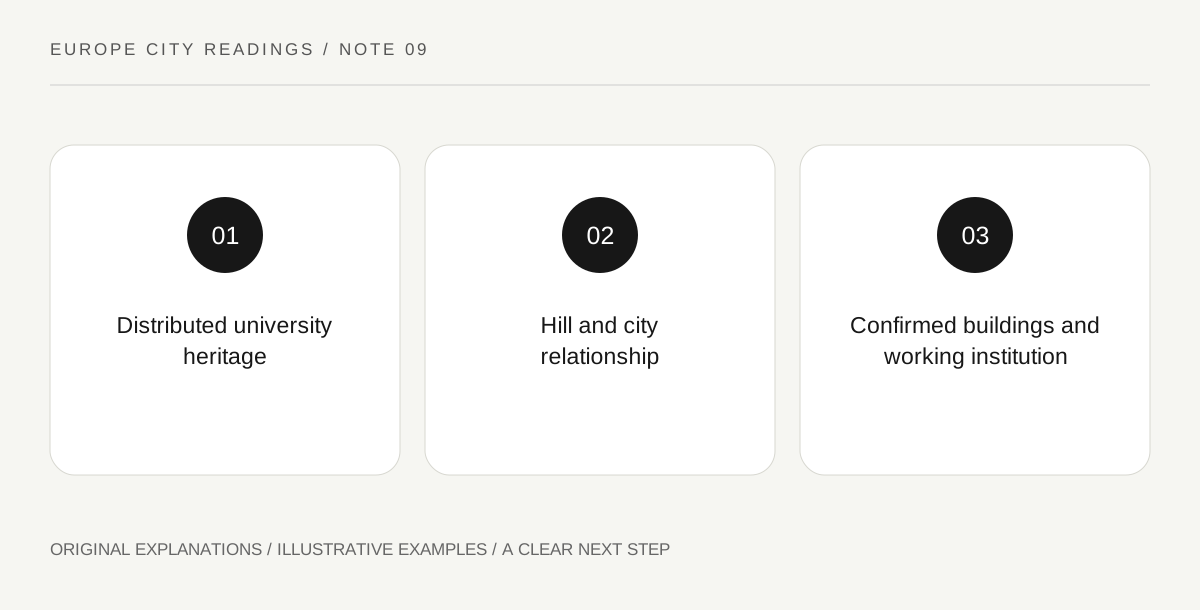
Original explanatory diagram. Read the full method and limitations below.
Begin with the two-component heritage geography
UNESCO describes the University of Coimbra–Alta and Sofia as an integrated university city with multiple buildings and historical phases. Put the upper area and Sofia component on a map before choosing a route. A heritage title can combine them conceptually without creating one compact ticketed interior. Identify the particular institution or space you intend to enter and how it relates to the surrounding streets. This helps distinguish a view of the university on the hill from an actual visit inside a named building. The city itself is part of the subject rather than merely the approach road to one famous room.
Use the hill as an observation theme
At a suitable public position, notice how height changes the visibility of buildings and the relationship between institutional space and the town below. Then compare that impression at street level. A short line on a map does not describe the effort, steps or accessible route between the two. Choose a route that fits the actual party and ask the relevant institution about access where needed. The observation question can remain the same even if the physical route differs. The goal is understanding how a hilltop place of learning relates to the town, not proving that every visitor can follow the steepest path.
Give different building periods their own roles
The heritage account includes a palace setting, library, colleges, scientific facilities and later university development. That range makes it useful to ask what each chosen building did rather than calling the whole ensemble medieval. Keep dates and functions attached to specific sites. A baroque-looking interior and a twentieth-century institutional space can both contribute to the university-city story while explaining different phases. Select two examples if time allows and compare how their layouts express learning, ceremony or administration according to reliable interpretation. A style label alone does not establish the original use of every room.
Respect a working institution while visiting heritage
The university remains more than a visitor attraction. Use its current tour and access arrangements and do not assume every open door, classroom or courtyard is available for sightseeing. A ticket for one experience should be read for what it actually includes. If a library or chapel has a specific entry process, build that into the chosen sequence rather than expecting the whole campus to share unrestricted hours. Keep student life and personal privacy in mind when photographing. A good visit connects institutional history, urban setting and the current place of learning, without turning ordinary academic activity into an uninvited performance for the camera.
Illustrative two-building study
A visitor maps the upper university area and Sofia, then chooses one confirmed interior and one public-space observation. A second documented building adds a different period or function if time permits. The notes separate construction phase, institutional role and hill relationship. No single ticket, unrestricted campus access or easy walking gradient is assumed.
Practical checks
Optional checkboxes save only in this browser.
Questions that come up
Is Coimbra’s university heritage just the famous library?
No. UNESCO describes multiple buildings, phases and urban relationships across Alta and Sofia. The library can be one important visit within a larger university-city story.
Does a university visit ticket open every academic space?
No such general access should be assumed. Read the exact experience and current institutional instructions, and respect teaching and restricted areas.
References and scope
These sources support the factual background. Examples and exercises are original illustrative teaching material. References do not imply endorsement.
- UNESCO: University of Coimbra — Alta and Sofia, hill setting, multiple institutional buildings and periods.