Ravenna’s Mosaics: Read the Room Before the Individual Image
Ravenna’s early Christian monuments hold mosaics within particular architectural and religious spaces. Looking only for famous details can hide that relationship. Begin with the room and the position of the image, then study one carefully interpreted scene or figure rather than trying to identify every small element immediately.
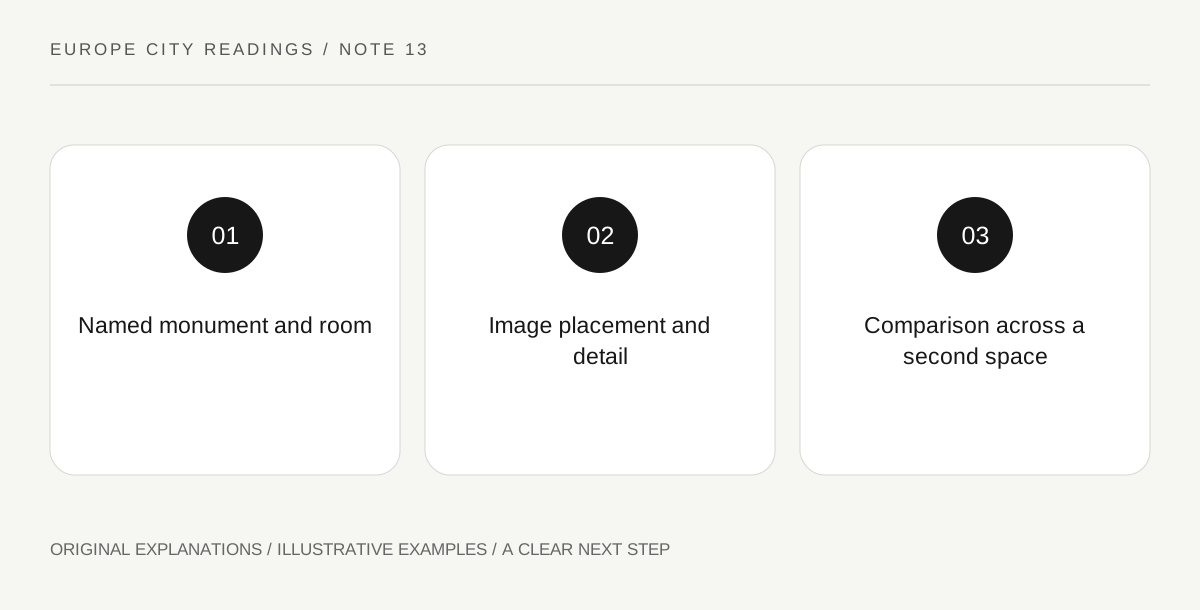
Original explanatory diagram. Read the full method and limitations below.
Choose named monuments rather than one mosaic stop
UNESCO identifies eight distinct monuments within Ravenna’s early Christian heritage property. Those sites are not one building, and shared recognition does not establish one admission system. Select the exact names that fit your interests and check their current visitor arrangements. A baptistery, basilica and mausoleum offer different spatial questions even when all appear in a mosaic guide. Map them deliberately and avoid assuming that a site outside your first cluster is a short walk away because it belongs to the same heritage title. The first decision is which architectural settings you want to understand.
Locate the image within the architecture
On entering a permitted space, notice the main direction of approach, the shape of the interior and where the mosaic occupies it. Is the image above, ahead, around a curved surface or along a sequence? Describe the relationship before moving to individual figures. A reproduction cropped into a flat rectangle can conceal the surface on which the image was made. Use the institution’s interpretation for the original function of the room rather than guessing from its present visitor flow. The modern place where a group stands may not reproduce the historical movement or viewing position of every user.
Study one detail through a reliable explanation
Choose a figure, object or border identified in an official label or guide. Notice how color, repetition and placement make it legible within the larger composition. Avoid inventing a complete symbolic dictionary from one familiar shape. A hand gesture, garment or object can require specialist context to interpret accurately. If a small detail is difficult to see under the permitted light, use an authorized reproduction or publication later rather than demanding extra lighting or crossing a barrier. The lesson is connecting a documented meaning with a visible arrangement, not proving that you can recognize every symbol without help.
Compare two spaces with one consistent question
After the first visit, carry a single question to the next monument: how does the building organize attention toward its principal image? Record what changes in scale, surface and viewpoint. This creates a meaningful comparison without turning the day into eight rushed admission scans. Respect religious practice and each site’s current conduct and photography rules. A mosaic is part of a vulnerable architectural setting, not a backdrop that visitors may touch or alter for a photograph. Your final note can include one whole-room observation, one interpreted detail and one comparison, with the source of the historical explanation clearly identified.
Illustrative two-room comparison
A visitor chooses two named monuments and asks the same question in each: where does the room direct attention? One detail per site is studied using reliable interpretation. Later notes distinguish the architecture, the image’s placement and the attributed meaning. The exercise does not assume every monument shares a ticket, opening time or identical visitor route.
Practical checks
Optional checkboxes save only in this browser.
Questions that come up
Are Ravenna’s listed monuments one museum interior?
No. UNESCO identifies distinct buildings. Choose the actual sites and confirm their current access rather than treating the heritage title as a single venue.
Can a cropped mosaic photograph explain the whole experience?
It can show detail, but may hide scale, surface and position within the room. Read the image together with its architectural setting.
References and scope
These sources support the factual background. Examples and exercises are original illustrative teaching material. References do not imply endorsement.
- UNESCO: Ravenna monuments — Eight distinct early Christian monuments and mosaic significance.