Pompeii: Study a Street and a Building Instead of Chasing Every Famous House
Pompeii is an archaeological urban landscape whose accessible buildings can change. A focused visit can connect one street, one confirmed building and the evidence used to explain them. That approach leaves room for understanding how the city worked without treating a famous-house list as a guaranteed route.
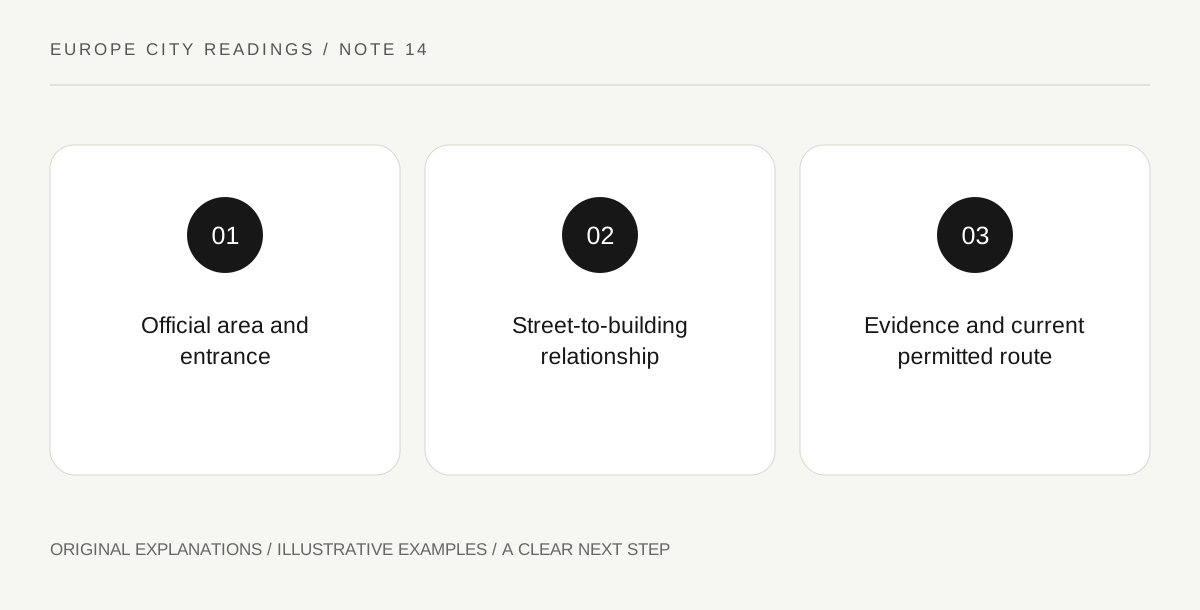
Original explanatory diagram. Read the full method and limitations below.
Begin with the archaeological park’s current access
The park publishes official entrances, ticket distinctions and information about visitable buildings. Use those sources to establish the part of the site your product covers and the entrance that fits the intended visit. A widely shared house photograph does not prove the building is open on your date. Likewise, a general Pompeii ticket name should not be assumed to include every related villa or wider park component. Write the exact included area beside the booking. This prevents the day’s main objective from depending on an access promise that the official product never made.
Choose an urban relationship to investigate
Select one manageable street segment and a building whose access is confirmed. Ask how the entrance, interior sequence and street relate. A doorway can reveal a connection between public movement and a more private space, but its historical use needs the site’s interpretation. Avoid labeling every counter-like feature a shop or every large room a dining room from appearance alone. The question is productive precisely because observation and archaeological explanation cooperate. A simple plan sketch can record the relationship without requiring you to identify every room or reproduce a technical excavation plan.
Distinguish surviving evidence from modern presentation
An archaeological site includes material in place, conservation measures, reconstructions and visitor infrastructure. Read labels for what the interpretation establishes about the chosen feature. Do not infer a complete ancient daily routine from a restored display or an isolated object photographed elsewhere. If an image or furnishing is represented rather than present, keep that distinction in the notes. The goal is understanding the evidence available in this particular location. A guide is especially useful when asked how scholars connect a visible feature with a proposed function, rather than being asked to invent a colorful biography for an unknown resident.
Keep the physical visit within the confirmed route
The park identifies a designated accessible route and specific entrances for that arrangement. Anyone needing particular access should consult the current details rather than assume an ancient street grid is uniformly easy to traverse. Follow barriers and current signs; a closed house is not an invitation to find another doorway. Give the chosen street-and-building study enough attention and leave optional sites genuinely optional. If the day’s conditions or closures require a shorter visit, preserve the interpretive question rather than rushing farther to complete a list. A well-understood piece of the city can provide a stronger memory than many unexamined thresholds.
Illustrative archaeological notebook
A visitor confirms one accessible building and an adjacent street segment using the park’s current information. The notebook has columns for visible feature, official explanation and remaining question. A famous house that is unavailable is removed from the plan without replacing it with unauthorized access. The visit still explains one clear public-to-building relationship in the ancient city.
Practical checks
Optional checkboxes save only in this browser.
Questions that come up
Are all famous Pompeii houses always open?
No. The park directs visitors to current information on visitable buildings. Treat a house photograph or old itinerary as background rather than a live access guarantee.
Can the same route suit every visitor with mobility needs?
Do not assume that. Consult the park’s current designated-access information and discuss specific requirements rather than inferring uniform access from the site map.
References and scope
These sources support the factual background. Examples and exercises are original illustrative teaching material. References do not imply endorsement.
- Pompeii Archaeological Park: visit information — Official entrances, ticket distinctions, building access and designated accessible route.