Dresden’s Neumarkt: Read Reconstruction as Part of the City’s History
A historic-looking cityscape can contain rebuilding, restoration and contemporary decisions alongside older material. Dresden’s Neumarkt and Frauenkirche offer a focused way to consider that relationship. Read the documented reconstruction history rather than judging authenticity only by whether a façade looks old in a photograph.
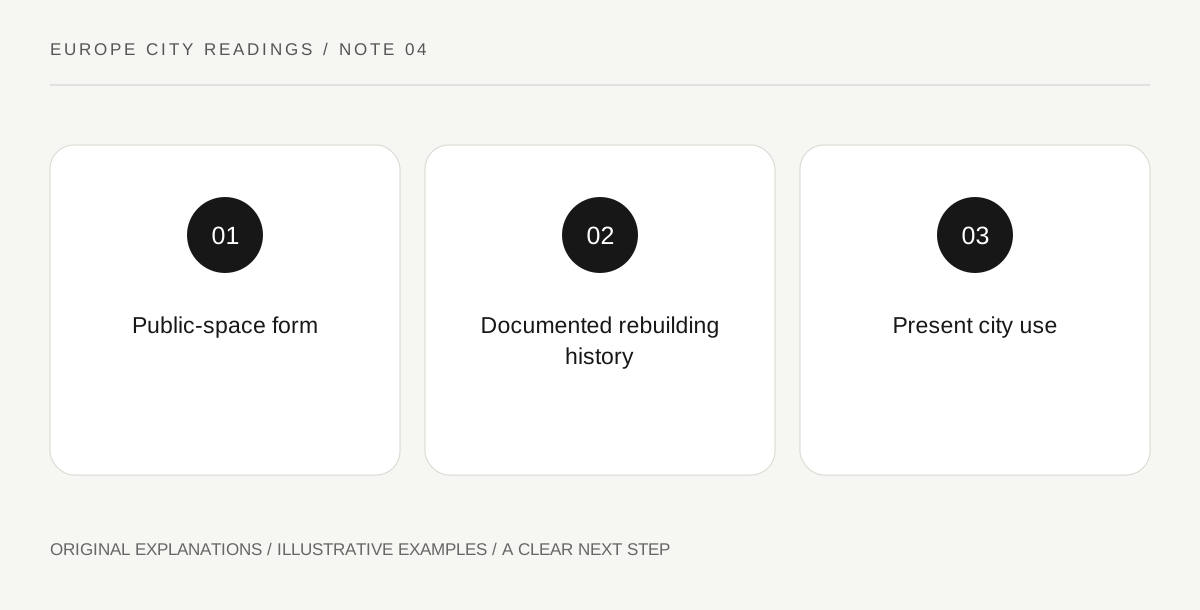
Original explanatory diagram. Read the full method and limitations below.
Begin with the city’s account of rebuilding
Dresden’s municipal townscape strategy identifies the rebuilding of the Frauenkirche and reconstruction around Neumarkt as important to the inner city’s development. That establishes reconstruction as part of the subject, not an embarrassing detail to omit. Choose one public viewpoint and identify the documented buildings around it. Keep their individual histories separate rather than calling the whole square either untouched old Dresden or entirely new. Those broad labels erase the precise questions that make the place interesting: what survived, what was rebuilt, which form was chosen and how the area functions in the present city.
Compare the square’s form with a building’s fabric
Stand where public access allows and describe the relationship between the square, street openings and surrounding frontages. Then choose one building for a more detailed historical account. Urban form and physical material are different levels of observation. A reconstructed frontage can restore a spatial relationship without making all its fabric old. Conversely, surviving material can sit within a setting that has changed substantially. A sketch showing edges and openings is useful because it focuses on the public space before a debate about whether an individual decorative feature looks convincingly aged.
Ask what an interpretation source actually establishes
A reliable display or building institution may explain a rebuilding phase, source documents or surviving elements. Record the claim with the building name and date. Do not infer an exact percentage of original fabric from contrasting stone colors in a distant view. Material differences may prompt a question, but they do not automatically answer it. If a guide explains a particular reconstruction decision, keep that explanation tied to its source rather than presenting your own preference as a historical verdict. The visit becomes a study in evidence and choices instead of a contest to identify which surfaces look most medieval.
Connect Neumarkt with the living inner city
Dresden’s strategy treats the inner city as an ongoing urban place with cultural, residential and other functions. Notice ordinary movement, entrances and current uses alongside the monumental views. A square can be meaningful to residents and visitors without operating as an outdoor museum at every doorway. If entering the church or another institution, use its own current visitor arrangements and respect any service or restricted period. Choose a short sequence that leaves time for both the space and its interpretation. A thoughtful page of notes should explain a relationship between past loss, rebuilding and present use, not merely reproduce the most familiar skyline image.
Illustrative reconstruction note
A visitor sketches Neumarkt’s public edges and selects one building for a documented reconstruction history. The notebook separates spatial form, stated rebuilding phase and observed present use. A visual contrast in stone is written as a question until interpretation explains it. The exercise avoids declaring the entire district either original or fake from a single view.
Practical checks
Optional checkboxes save only in this browser.
Questions that come up
Does a historic-looking façade prove uninterrupted survival?
No. Appearance alone does not establish construction history. Use reliable building and city records to understand rebuilding, restoration and surviving elements.
Does reconstruction make a place historically uninteresting?
It creates a different historical question. The choices, evidence and present urban relationships can be studied carefully without pretending that every visible surface is old.
References and scope
These sources support the factual background. Examples and exercises are original illustrative teaching material. References do not imply endorsement.
- Dresden municipal townscape strategy — Frauenkirche and Neumarkt reconstruction within the changing inner city.