Riga’s Alberta Street: Read an Art Nouveau Façade From Ground to Roof
Alberta Street offers a concentrated encounter with Riga’s Art Nouveau architecture, but ornate details become more meaningful when read as parts of a whole façade. Choose two buildings, compare their organization and use reliable interpretation for names and meanings. The street remains a lived urban place while you look.
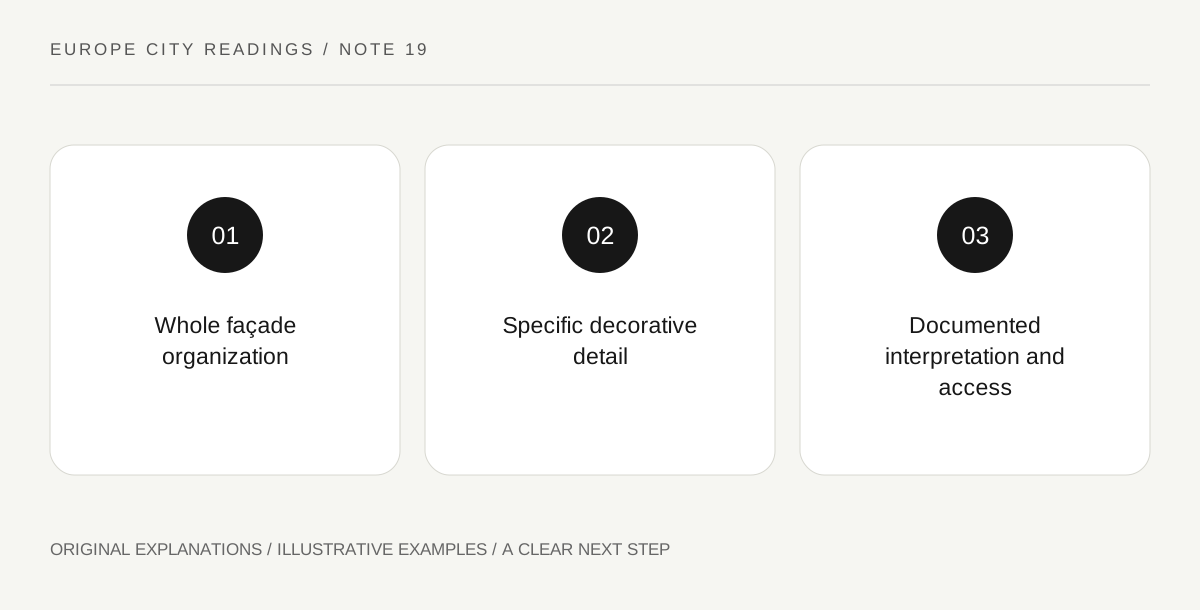
Original explanatory diagram. Read the full method and limitations below.
Keep the street and period specific
LiveRiga identifies Alberta Street with early-twentieth-century Art Nouveau buildings and describes its concentration of decorated façades. Start with the exact building addresses rather than calling every ornate structure in the city the same style. Record any architect and date supplied by reliable local interpretation. A general style name helps orientation, but individual buildings can organize decoration differently. A short, attentive visit can therefore reveal variety rather than simply accumulate the same adjective. Put the two selected frontages on a small map and choose public positions from which they can be viewed without blocking doors or traffic.
Read the whole elevation before the sculpted face
Begin at street level with entrances and the relationship between building and pavement. Move your attention upward through windows, balconies, repeated divisions and the roofline. Then identify where the most expressive sculptural or decorative elements sit within that organization. This sequence prevents a memorable face or animal from becoming the entire account of the building. A photograph cropped tightly around one motif cannot show how it directs attention across the façade. Sketching a few major lines can help you understand the arrangement even if you have no specialist vocabulary for every ornament.
Compare two buildings using the same visible questions
Ask where each façade appears symmetrical, where a balcony interrupts the rhythm and how decoration relates to windows or entrances. Write observations before searching for symbolism. A face can be described as a face; naming a mythological identity or moral meaning needs an attributed explanation. The city’s official information can guide further learning at the Art Nouveau Museum, but a museum interior is a separate experience with its own access. Do not assume an open residential doorway grants permission to inspect the staircase. Architectural curiosity should preserve the distinction between public street looking and entry to private space.
Use an interior visit to add a different question
If the museum fits the day, confirm its current operation and ask how interior design and domestic life relate to the exterior architecture you have observed. That extends the study beyond façade ornament without claiming that one museum room represents every household on the street. If you remain outside, describe the visit accurately as an exterior architectural walk. Keep the note modest: two addresses, their documented identities, a structural comparison and one question for future reading. The street’s richness does not require a universal theory of Art Nouveau or an invented explanation for every carved figure to become memorable.
Illustrative two-address sketch
A visitor selects two Alberta Street addresses and sketches entrance, window rhythm, balconies and roofline for each. One sculpted detail is added only after the whole façade is understood. Historical names come from reliable interpretation, while an unknown symbol remains a question. A museum visit is recorded separately if it actually occurs; private doors remain ordinary residential boundaries.
Practical checks
Optional checkboxes save only in this browser.
Questions that come up
Can I identify every ornament’s meaning by appearance?
You can describe what is visible, but historical or symbolic identification needs reliable interpretation. Keep observation separate from an attributed explanation.
Does an open door allow visitors to inspect a residential staircase?
Not automatically. Use explicit visitor arrangements or permission. Street viewing and access to a private interior are different things.
References and scope
These sources support the factual background. Examples and exercises are original illustrative teaching material. References do not imply endorsement.
- LiveRiga: Alberta Street — Early twentieth-century Art Nouveau façades and separate museum context.