Vienna’s Ringstrasse: Compare Building Style With Public Purpose
The Ringstrasse is a useful place to learn that buildings standing beside one another need not speak the same architectural language. Vienna’s boulevard brings cultural and public institutions into a deliberately monumental setting. Choose a short section and compare how two buildings present their roles to the street.
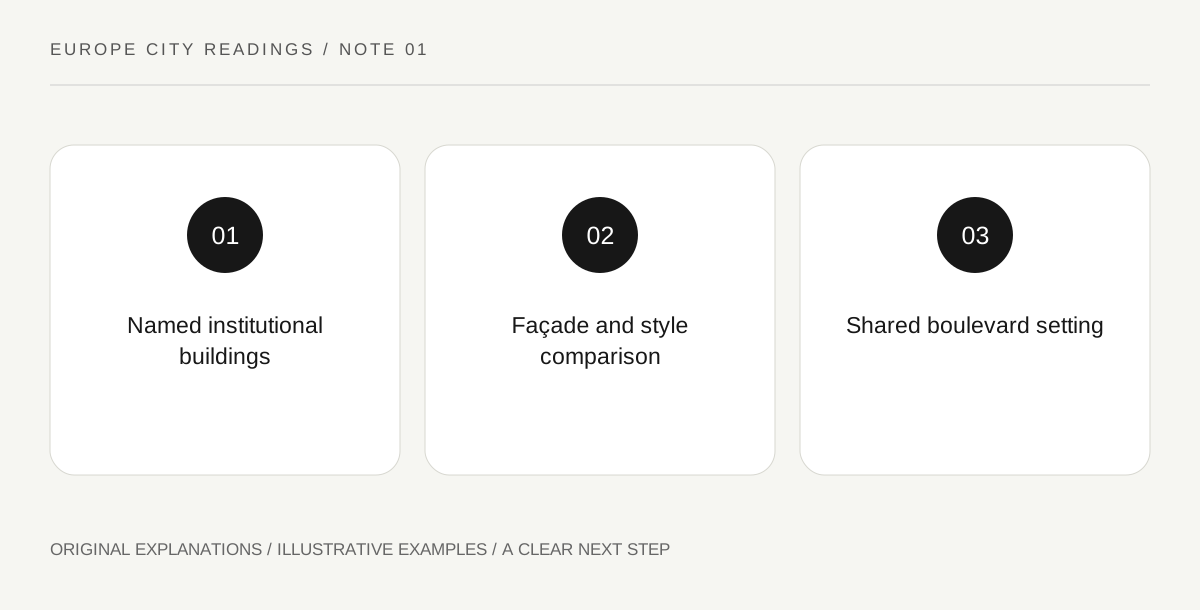
Original explanatory diagram. Read the full method and limitations below.
Start with two institutions rather than the full ring
Vienna’s official introduction identifies buildings such as the State Opera, university and major museums along the boulevard. Choose two that interest you and establish their current function and historical identity from reliable interpretation. A complete circuit is not necessary for a first architectural reading. Mark the actual entrances if you intend to visit inside, since an imposing front view can differ from the operational visitor doorway. The outdoor comparison can remain worthwhile even without an interior booking, but it should not be mistaken for admission or a complete account of the institution’s collection.
Read the façade as an organized invitation
From a safe public viewpoint, identify the central entrance, repeated windows, major horizontal divisions and any prominent roofline. Ask how those features direct attention and how the building meets the pavement. Then compare the second institution using the same visible questions. You do not need to label every column order to notice whether an approach feels ceremonial, open or enclosed. Record the observation before attaching a historical explanation. A wide stair may communicate monumentality, but its original intended symbolism needs a source rather than a confident guess based only on how the steps feel today.
Use style names with dates and specific buildings
The tourist board identifies several historical styles and supplies building histories, including the State Opera’s neo-Renaissance character and reconstruction after wartime destruction. Keep a style label connected to the named building and phase rather than treating it as proof that the structure itself dates from the Renaissance. Historicist architecture can refer to an earlier visual language while belonging to a later city-building project. This distinction makes the boulevard more intelligible: you can ask why a public institution adopts a particular vocabulary without confusing reference with age. Where later alterations are documented, keep them visible in the description.
Connect the buildings through the boulevard space
Look beyond façades to the spaces between them: street width, planted areas, crossings and the distance from one frontage to another. The Ringstrasse works as an urban sequence, not just a row of isolated objects. Plan legal crossings and ordinary public stopping places instead of trying to photograph from traffic lanes or cycle routes. If adding an interior, check that institution’s current admission and opening information independently. A useful visit note includes one building comparison and one observation about the boulevard that connects them. That gives the walk a clear intellectual shape without making it a race to collect every famous address.
Illustrative two-building page
A visitor compares two documented Ringstrasse institutions using entrance, repetition, roofline and street relationship. The visitor adds the official style and construction information in a separate column, then notes how the boulevard creates a shared monumental setting. A later reconstruction phase remains identified. The exercise produces a short architectural comparison rather than a list of all buildings around the ring.
Practical checks
Optional checkboxes save only in this browser.
Questions that come up
Does neo-Renaissance mean a building was built during the Renaissance?
No. It describes a later use of a historical architectural language. Keep the actual construction and alteration dates beside the style term.
Must I walk the entire Ringstrasse to understand it?
No. A focused section can reveal the relationship between institutions and boulevard space. A deliberate comparison is more useful than an incomplete attempt to inspect every frontage.
References and scope
These sources support the factual background. Examples and exercises are original illustrative teaching material. References do not imply endorsement.
- Vienna Tourist Board: Ringstrasse buildings — Contrasting historical styles and institutional buildings on the Ringstrasse.