Bilbao’s Estuary: Read Urban Change Beyond the Museum Façade
Bilbao’s estuary gives a visitor a way to connect industrial history with contemporary public space and architecture. The Guggenheim can be one important element without becoming the whole city. Choose a short waterside sequence and ask how buildings, crossings and river-edge uses relate to one another.
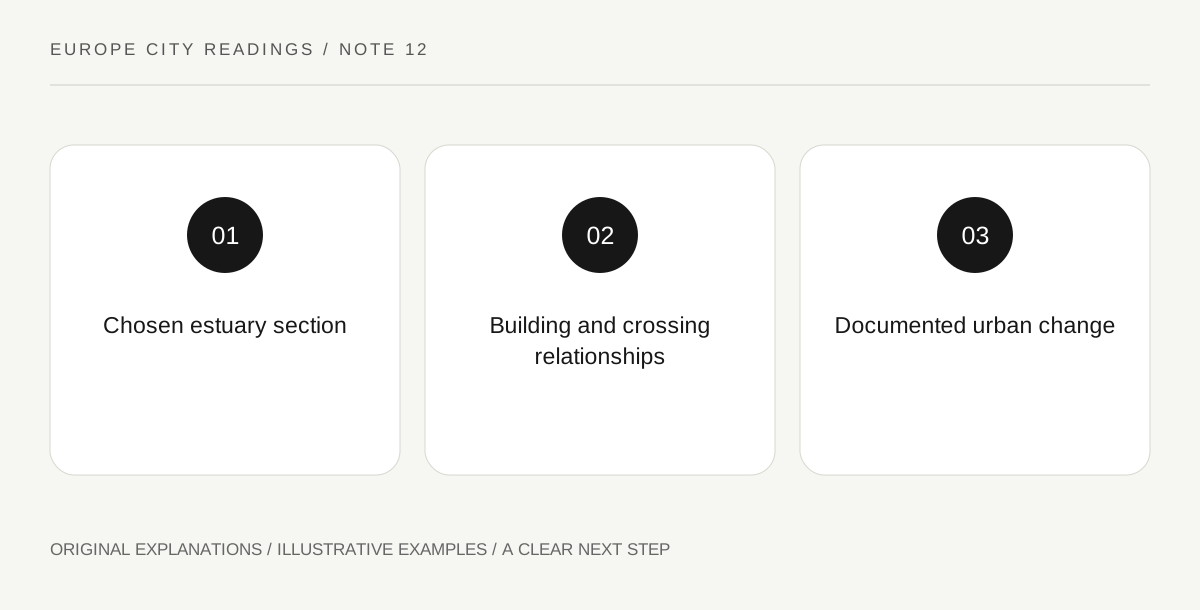
Original explanatory diagram. Read the full method and limitations below.
Use the estuary as the organizing line
Bilbao’s official visitor material describes the Nervión estuary as the city’s backbone and connects its banks with urban change. Start with one manageable section rather than trying to absorb the entire regional waterfront. Mark both banks and the actual public paths you intend to use. A museum building, bridge and former industrial setting can create a useful sequence if their relationship is clear. Do not assume a photograph of a long riverside skyline establishes an uninterrupted pedestrian route at every point. The actual access map and current local notices determine where the public walk can go.
Compare what a building does at the water edge
At an authorized viewpoint, notice whether a building presents an entrance, a blank service edge, a terrace or a public route toward the estuary. Then compare another site along the chosen section. This shifts attention from judging façades as isolated sculptures to reading their urban relationship. Use reliable interpretation for a building’s designer, date and earlier use. An industrial-looking feature can prompt a question but does not automatically identify a former shipyard or factory. A contemporary cultural building also has service and public sides that may be experienced differently depending on where you stand.
Read a crossing as part of everyday movement
A bridge can be visually memorable while also solving a practical connection between neighborhoods or river paths. Identify its legal pedestrian access and where the crossing leads at both ends. Ask how the view changes between bank and crossing, using stopping places that do not obstruct movement. Do not treat an operational or restricted structure as an observation platform simply because it appears in a waterfront photograph. A useful sketch can show the river, two public edges and the connection between them. The diagram describes your chosen section rather than claiming to map every movement system in Bilbao.
Give an interior visit a separate purpose
If the Guggenheim or another museum is part of the day, choose a current exhibition or collection question and confirm admission independently from the outdoor walk. An exterior encounter is a legitimate architectural experience, but it should not be described as a visit to the interior collection. Leave enough attention for whichever component matters most. The official walking material can supply orientation without obliging you to reproduce its entire itinerary or estimated family pace. A thoughtful Bilbao day links a specific piece of urban change with one interior or public-space study, leaving the estuary as the thread that makes those choices coherent.
Illustrative estuary sequence
A visitor selects one public bank section, a confirmed pedestrian crossing and a museum exterior. Notes compare how each meets the water. A separately booked interior is included only if it fits the chosen focus. A structure’s industrial role is recorded only when interpretation identifies it, and no claim is made to have tested every waterfront route or viewed an unvisited collection.
Practical checks
Optional checkboxes save only in this browser.
Questions that come up
Is Bilbao’s urban story limited to the Guggenheim?
No. The official visitor account uses the estuary to connect a wider industrial and contemporary city landscape. The museum can be one element within that relationship.
Does an industrial appearance identify a former function?
Not by itself. Use reliable interpretation for the specific structure and keep a visual observation separate from a documented historical use.
References and scope
These sources support the factual background. Examples and exercises are original illustrative teaching material. References do not imply endorsement.
- Bilbao official family walks — Estuary as city spine and industrial-to-contemporary urban change.