Gdańsk’s Main Town: Connect the Merchant Streets With the Waterfront
Gdańsk’s decorated streets and waterfront become more informative when read as parts of a trading city. Civic buildings, merchant spaces and harbor infrastructure ask different questions. Choose a short route that connects one inland public space with one documented waterside feature instead of treating the river edge as a backdrop.
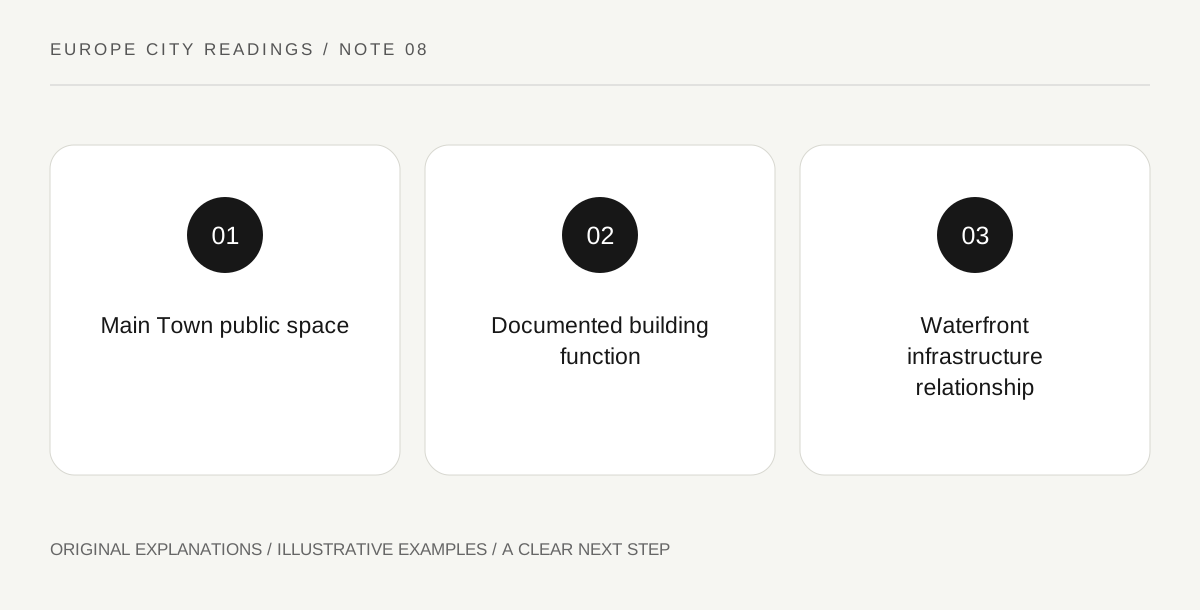
Original explanatory diagram. Read the full method and limitations below.
Keep Main Town distinct in the place names
Gdańsk’s official tourism material places many familiar monuments in the Main Town and connects the city with Hanseatic trade. Retain the specific district and street names when mapping the visit. A broad old-town phrase can be convenient in conversation but may hide a more precise local geography. Locate the public space you want to study and the waterfront feature that gives it context. The purpose is a relationship: where civic or merchant activity appears in the street scene, and how movement toward the water helps explain the city. One well-chosen pair can be enough for a focused first walk.
Read a decorated frontage as more than ornament
At a public viewpoint, compare the width of a building frontage, its entrance and the way it joins neighboring structures. Use reliable interpretation to establish its earlier function rather than assigning every elaborate house to a wealthy merchant by appearance. A decorative figure or inscription may carry a particular meaning, but that meaning needs an attributed explanation. Keep construction and rebuilding history with the specific building if it is supplied. A historic-looking streetscape does not mean all material has survived unchanged. The interesting question is how the documented building and the public street express the city’s commercial and civic life.
Give a waterfront structure a functional question
The city’s tourism account identifies the Crane among its notable architecture. A harbor crane offers a different kind of evidence from a ceremonial frontage: it raises questions about lifting, movement and the relationship between water and stored goods. Use the museum or site’s current interpretation to understand the particular structure and access. Do not infer that every waterside building is a warehouse or that every old mechanism still operates for visitors. A simple sketch showing water, quay and the identified feature can connect the practical role to the street sequence you have just observed.
Choose interior access as a separate layer
An exterior walk can reveal urban relationships, while a museum or historic interior can supply the evidence needed to interpret them. Check the current venue’s opening and ticket before making it the day’s fixed center. If an interior is unavailable, the outdoor question remains useful, but avoid pretending you saw its collections. Record what was observed, what a reliable source explained and what remains uncertain. Follow public paths beside working or restricted waterfront areas. A successful maritime-city visit links the visible urban form with documented functions instead of collecting canal reflections and claiming the port history explains itself.
Illustrative street-to-water study
A visitor selects one Main Town civic or merchant-related space and a documented waterfront structure. The notebook compares frontage, public space, water access and the structure’s stated function. Building history comes from reliable interpretation, not from the age implied by decoration. The result is a connected account of trade and city form without inventing an interior visit or a working mechanism demonstration.
Practical checks
Optional checkboxes save only in this browser.
Questions that come up
Is every ornate house automatically a merchant house?
No. Appearance can prompt a question, but the specific building’s documented function and history provide the answer.
Does the waterfront explain itself without interpretation?
Some relationships are visible, but the earlier use of structures and mechanisms needs reliable context. Pair observation with one accurately interpreted feature.
References and scope
These sources support the factual background. Examples and exercises are original illustrative teaching material. References do not imply endorsement.
- Gdańsk Tourism: city introduction — Hanseatic maritime trade, Main Town and surviving civic architecture.