Bratislava Across the Danube: Look Beyond the Old Town Postcard
Bratislava’s Old Town and Petržalka offer different urban perspectives across the Danube. A visit that includes both can reveal river edges, housing and public space that disappear from a single castle-and-rooftops photograph. Choose a modest public route and compare how each bank relates to the water.
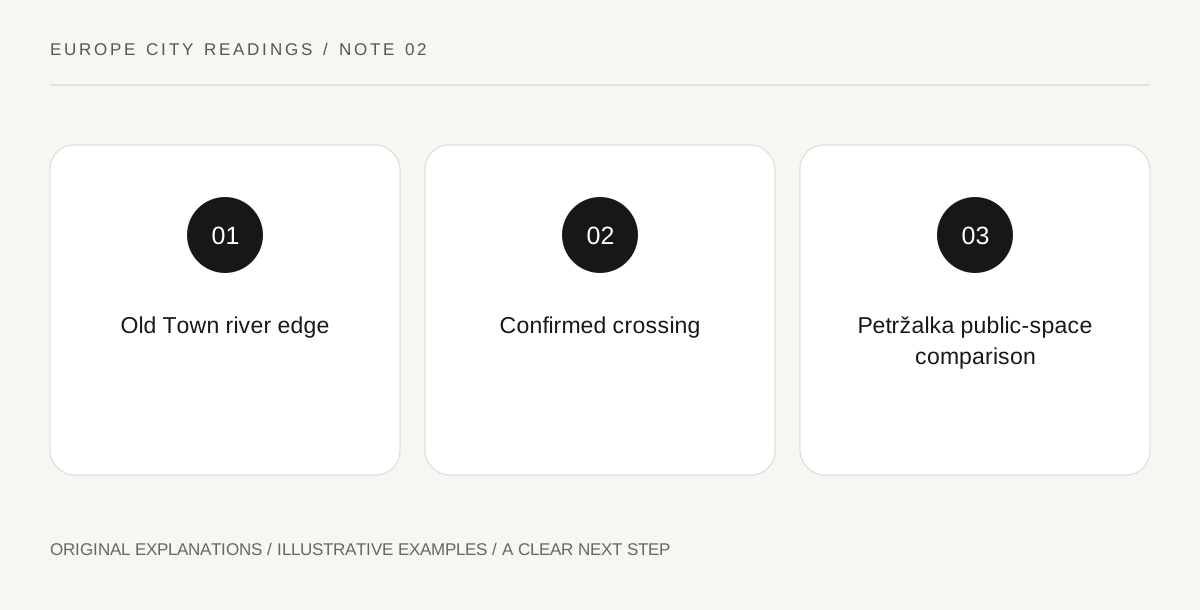
Original explanatory diagram. Read the full method and limitations below.
Use the river to organize the city
Bratislava’s tourist board presents Petržalka as a setting of contrasts, including large-scale housing and green areas south of the center. That gives a river-bank comparison a clear purpose beyond crossing a bridge for another photograph. Put the Old Town side, the Danube and the selected Petržalka public space on a small map. Do not assume the view from one bank describes the daily life or history of the other. The river is both a connection and a division, and a useful first question is how streets and public routes bring people to its edge.
Choose the crossing for the actual activity
The tourism board publishes a cycling loop, but a cycling itinerary is not automatically a walking recommendation of the same length or duration. Use current pedestrian information and a suitable bridge approach for your intended visit. Identify where the crossing deposits you, how you reach the chosen public space and how you return. A bridge seen in the skyline may not have the access arrangement you imagined from a broad map. If you use public transport for one leg, confirm its current stop and ticket rather than importing a route number from an older guide. Keep the crossing a deliberate connection, not an improvised shortcut.
Compare public space at a human scale
At an authorized stopping place, note where people can sit, walk, cross a path or approach the water. Then compare building scale and the distance between buildings and open space. These observations can be made without entering residential courtyards or treating a neighborhood as an exhibit. Avoid describing all prefabricated housing as one anonymous landscape; a local explanation can supply the specific history and current use. The visual comparison should generate questions about urban design rather than a simplistic verdict that the historic side is authentic and the other side is merely modern.
Keep a special event separate from everyday transport
Bratislava’s official event information sometimes describes temporary services or revivals of historic river crossings. Those can be interesting opportunities, but a festival boat mentioned for one date is not an everyday ferry timetable. Read the current provider and date if a boat ride is part of the plan. The broader bank comparison remains possible without depending on a special service. Record which parts of the visit are permanent urban geography and which are a dated activity. This keeps an appealing historical story from becoming a missed connection when a traveler returns to the city in another month.
Illustrative bank comparison
A visitor selects a legal pedestrian crossing and one public space on each side. Notes compare building scale, river access and places to pause. A temporary boat event appears in the research but is excluded because it does not run on the chosen date. The route remains a modest observation exercise, not a copied cycling circuit or a claim about every part of Petržalka.
Practical checks
Optional checkboxes save only in this browser.
Questions that come up
Is the tourist board’s full cycling loop a ready-made walking plan?
Not automatically. Distance, access and pace need to fit the actual activity. Use current pedestrian information and choose a manageable section.
Does a historic boat event establish a regular ferry service?
No. A dated revival or special event has its own schedule. Use the actual provider’s current information rather than treating an event description as everyday transport.
References and scope
These sources support the factual background. Examples and exercises are original illustrative teaching material. References do not imply endorsement.
- Bratislava Tourist Board: Petržalka — Distinct Danube-bank urban fabric and public-space contrast; no cycling itinerary copied.