Budapest’s Danube: Compare a Hilltop View With the Opposite Bank
Budapest’s river landscape can be understood through a pair of viewpoints rather than a race between every monument. A view from Buda and a public river-edge view from Pest reveal different relationships among water, buildings and height. The useful question is how each side makes the other legible.
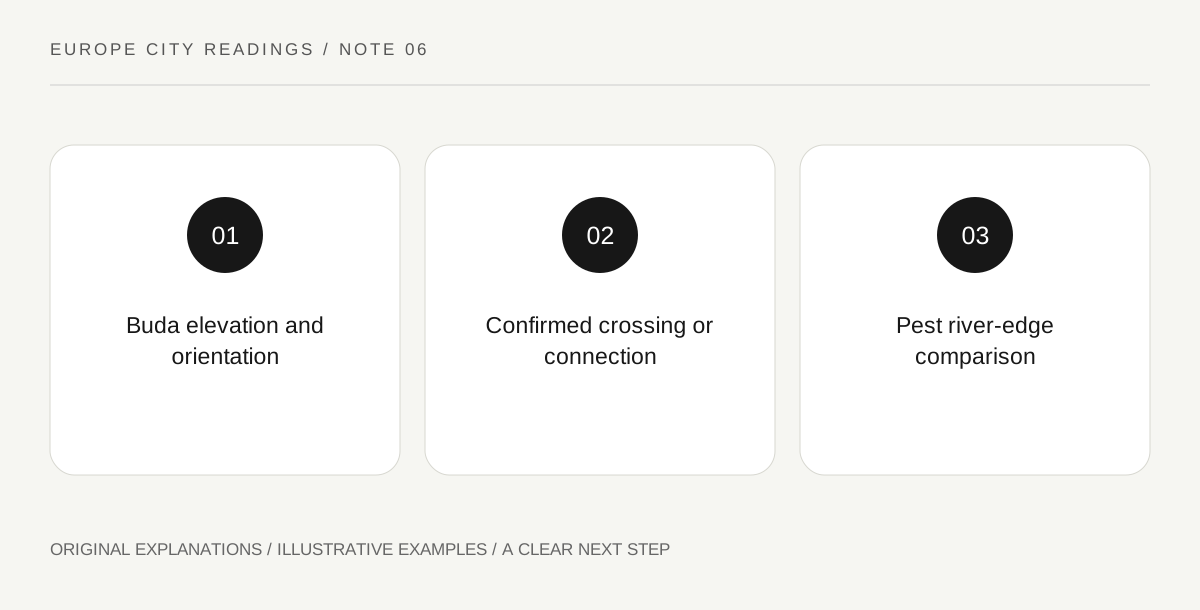
Original explanatory diagram. Read the full method and limitations below.
Locate Buda, Pest and the chosen river edge
Budapest’s official heritage itinerary connects the Buda Castle district with views toward the Danube and Pest. Begin by placing the two banks and the actual viewpoints on a map. A photograph showing a monument across the water does not place the camera beside it. This simple distinction prevents repeated crossings caused by following image captions as though they were addresses. Choose one permitted upper viewpoint and one manageable river-edge location rather than assuming every famous panorama belongs in a single afternoon. Keep the route between them separate from the visual comparison itself.
Read the upper view as a map of relationships
At the confirmed viewpoint, identify the river, opposite bank and major visible building masses using a reliable map or label. Notice how elevation changes the apparent distance and alignment. A bridge can look close from above while its pedestrian approach requires a different route at ground level. Describe the view without inventing access to a roof, terrace or structure you have not checked. The purpose is orientation: which elements sit together, which lie across the river and how the city’s scale becomes visible. A panoramic photograph can support that learning if taken from an authorized position without blocking circulation.
Use the opposite bank to change the question
At a public river-edge location, look back toward the higher ground and compare the skyline with the buildings and movement at street level. You are no longer reading a map from above; you are observing how the city meets the water. Notice the distance between the pedestrian space and the river, the route of crossings and the relationship between monumental frontage and ordinary access. Do not step into traffic areas or operational river infrastructure for a cleaner angle. A river view can remain useful from a place designed for public circulation, even if it does not reproduce an ideal promotional image.
Connect interpretation with the actual visit conditions
The official Buda itinerary gives historical and visitor context for particular sites, but current construction, access and institutional rules still need to be checked at the places chosen. A church, bastion level and public street can have different permissions and operating conditions. If a planned viewpoint is unavailable, choose another authorized position that preserves the comparison rather than forcing a restricted entrance. Record the viewpoint names and directions in your notes so later photographs do not merge into one vague Budapest panorama. The finished observation should explain how topography and river geography organize the city, not simply list which monuments were visible.
Illustrative paired views
A visitor selects one authorized Buda viewpoint and one public Pest-side river location. From the first, the visitor labels river, bridge and opposite-bank buildings. From the second, the visitor sketches the hill skyline and street-level river edge. The two notes answer different questions, while the connection between them follows current local access rather than an assumed direct line.
Practical checks
Optional checkboxes save only in this browser.
Questions that come up
Does a photograph of a landmark identify the bank where it was taken?
Not necessarily. Many views look across the Danube. Locate the camera position and subject separately before planning a route.
Does a named heritage viewpoint guarantee every terrace is freely accessible?
No. Different levels, buildings and institutions have their own current access conditions. Use the specific visitor information and on-site instructions.
References and scope
These sources support the factual background. Examples and exercises are original illustrative teaching material. References do not imply endorsement.
- Budapest official Buda heritage tour — Castle district, civic quarter and views across the Danube to Pest.